On this page
By Spider Web Rice Field Editorial Desk
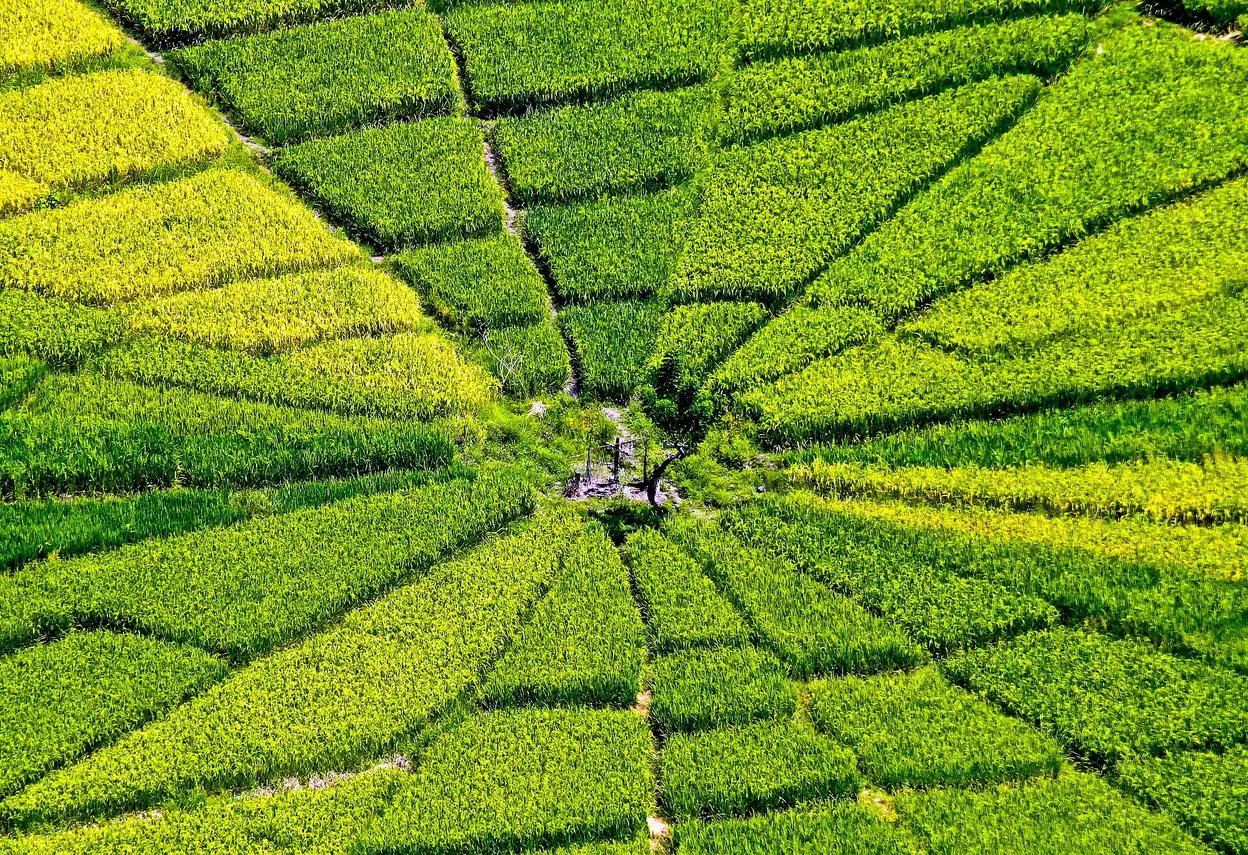
Lodok meaning, in short: the centre point of a Manggarai lingko field, the spot from which long lines run out to the outermost plot, called cicing. That is how a Meler study and the regency tourism office use it. Kompas uses the word more broadly for the land-division system as a whole, so context decides which sense applies.
Lodok meaning: what does the word refer to?
Two senses are in print, and they are easy to keep apart once you have seen both. The narrow sense is a place. A study of Meler glosses lodok as centre point, and lingko as area, field, land or garden. The regency tourism office uses it the same way when it describes long lines running from a central point called lodok to the outermost field called cicing.
The wider sense is a system. Kompas (2022) calls lodok the land-division system itself, with cicing as its outer part. Writers then combine the words freely, which is how you get "lingko lodok" and "Lodok Lingko Ratung". When a sign or an article says lodok, ask whether it means a point on the ground or the whole method of dividing land around that point. Both uses appear in writing about the spider web rice field at Cancar, while the tourism office's own destination name for the site is Lingko Meler, without the word at all.
What marks the centre?
The marker varies, and sources describe at least three arrangements. Do not expect one standard object.
| Marker at the centre | Who describes it | Context |
|---|---|---|
| Teno tree or teno wood | 2019 journal article; provincial official quoted by Mongabay | Straight, leafy tree usually planted at the centre; planted in a ritual called tente |
| Wooden pole and a rock | Travelfish | Pole read as male, rock as female; together they form the ritual centre |
| Compang altar | Detik | Detik says lines usually start from a compang, while others put a teno post there |
Teno, then, is not a synonym for lodok. Lodok names the position; teno names a tree or post that may stand there. Flores Exotic Tours, an operator, speaks of a pole from which lines were drawn to the outer circle according to family size, and calls the segments moso, meaning hand. That fits the same idea without using the word teno.
What is cicing?
Cicing is the other end of the line: the outermost field or edge of the circle, in the wording of both the tourism office and Kompas. It should not be confused with rahit, which Detik reports as the line between the lingko of different villages. Cicing belongs to one lingko's own geometry. Rahit is a frontier between communities.
For a visitor the pair is a good way to read a view. Bali Genie advises framing the whole circle first, including the centre and the outer edge, which is another way of saying that a viewpoint shows you lodok and cicing together. Trace one narrow wedge from the point to the rim and you have followed a single share of land from end to end.
What rites happen at the lodok?
The centre is where sources locate ritual. The 2019 article says rites in a lingko are usually held at the lodok, which the community treats as sacred. Travelfish describes a ceremony there at planting and harvest. Beyond that, accounts differ by community, and none should be taken as a fixed script.
- Founding the division. The provincial official quoted by Mongabay says it starts with tente, planting teno wood, and that goat blood spilled on the wood makes the division valid in custom. Detik describes a red rooster at Gendang Nampo.
- A longer sequence. Detik, citing research on Gendang Nampo in Cibal Barat, lists barong boa, teing hang, reke lodok, wuat wa'i and lilik compang before fields are divided. That is one community and not Cancar.
- The farming cycle. A Gadjah Mada University thesis abstract puts the batir, kalok, hang rani and penti ceremonies after moso division, clearing and burning.
- Penti. Wikipedia lists Barong Lodok, a rite inviting the guardian spirit to the lingko centre, within the Penti harvest thanksgiving. Our page on the Penti ceremony has more.
The measuring itself also happens here. Detik reports that during division a tu'a teno sits at the centre while small stakes called lance koe are spaced by his fingers, a measure called sor moso.
How do lodok, cicing, teno and moso fit together?
Think of one circle read from the middle outwards. Each term names a different part of it, and only the first two are positions on the ground. Spellings and details shift between communities, so take this as a reading aid for the sources cited on this page.
| Term | What it names | Type of thing |
|---|---|---|
| Lodok | The centre point, or by extension the whole division method | Position; system |
| Cicing | The outermost field or edge | Position |
| Teno | A tree or post that may stand at the centre | Object |
| Moso | The share measured out; a Cancar resident quoted by Mongabay and the operator Flores Exotic Tours both gloss it as hand | Measure |
| Tu'a teno | The elder who manages allocation | Person's role |
Why does the centre matter?
Practically, because every share is defined from it. Move the centre and each wedge changes. How those wedges are sized is disputed: a Cancar resident told Mongabay that the tu'a teno and tu'a golo generally receive larger shares, whereas Kompas (2017) says each owner has the same size. Our article on moso land division sets out the finger measures, and the wider picture is in how lingko rice fields work.
Socially, because it ties land to people with authority over it. The Jakarta Post has the tu'a teno managing who receives customary land, with the allocating done at the mbaru gendang. Detik adds a historical turn: outside powers including Goa-Tallo, Bima and the Dutch weakened the authority of tu'a golo and tu'a teno by appointing gelarang and dalu. So the standing of the people who answer for a centre has not been constant.
Symbolically, the circle has been read as larger than farming. The Jakarta Post says the land form relates philosophically to mbaru niang houses, with a central pillar and eight outer poles. Anyone tempted to walk out to a lodok for a photo should bear in mind the journal's word for it, sacred, and read our notes on spider web rice field etiquette first.
What else do readers ask about lodok?
What is a lingko lodok?
A lingko is a customary field or area of land, and the lodok is its centre point. Together the phrase usually means a circular field divided by lines running out from that centre to the rim.
What does lodok mean in Cancar?
The same as elsewhere in the Manggarai sources: the centre point of a lingko, in the wording of a Meler study. Travelfish, describing Cancar, says ceremonies are held there at planting and harvest.
What is the cicing in Cancar?
The outermost field or edge of the circle. The regency tourism office describes lines running from the lodok to the cicing, and Kompas calls it the outer part of the system.
How is the lodok marked in Cancar?
Travelfish, writing about Cancar, describes a wooden pole and a rock forming the ritual centre. Other accounts of Manggarai fields mention a teno tree or post, or a compang altar, so the marker varies from place to place.
What is the difference between lingko and lodok?
Lingko is the land or field as a whole. Lodok is the centre point inside it, though Kompas also uses lodok for the entire land-division method. Read the surrounding sentence to see which is meant.
Which sources support this page?
- Tourism journal article on Meler (2025)
- Manggarai Regency tourism office: Lingko Meler
- Kompas (2022): Lodok Lingko Ratung
- Jurnal article on the teno tree and lingko (2019)
- Mongabay (2017): spider web fields of Manggarai
- Travelfish: Cancar spider web rice fields
- Detik: the Lodok system of land division
- Flores Exotic Tours: Lingko Cara
- Bali Genie: Lingko spider web rice fields
- Gadjah Mada University thesis abstract on lodok lingko
- Wikipedia: Manggarai people
- Kompas (2017): promoting the Lingko Lodok fields
- Jakarta Post (2013), via Yahoo News
How do I reach the desk?
Corrections to this glossary and travel questions both reach the desk by WhatsApp 6281139414563 or bd@juaraholding.com. Travel requests can turn into paid bookings, so we are not a neutral party there.
Send the desk your dates and route across Flores. The desk replies in writing.
Ask the desk on WhatsApp bd@juaraholding.com