On this page
- What does lingko mean?
- How do lingko rice fields form the web pattern?
- Who decides the shares?
- Which animal seals a new division?
- Are all plots equal?
- Is the system still in use?
- What should this change about your visit?
- What else do people ask about lingko land?
- Which sources support this page?
- How do I reach the desk?
By Spider Web Rice Field Editorial Desk
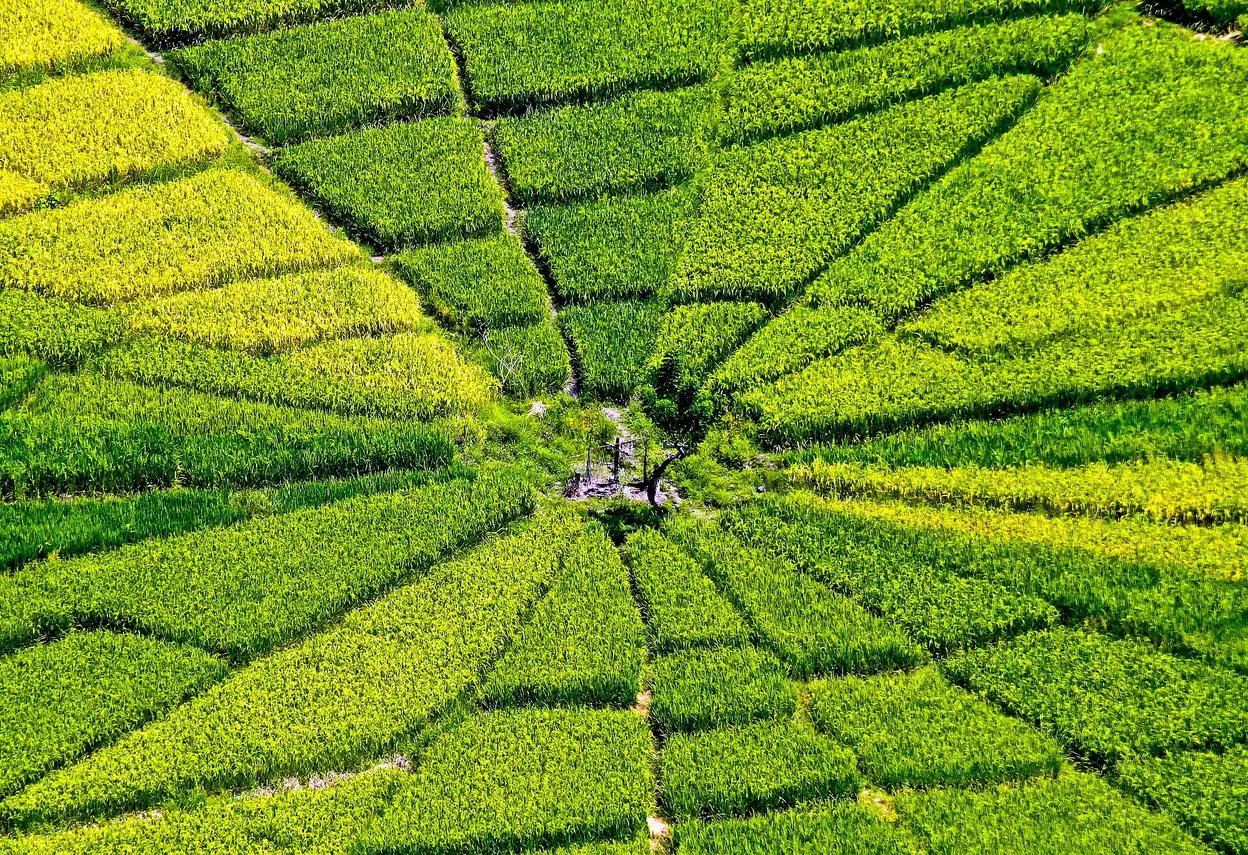
Lingko rice fields are customary land in Manggarai, western Flores, divided among the people of a community. The regency tourism office describes lines that fan out from a centre called the lodok to an outermost field called the cicing. Atlas Obscura credits later subdivision among descendants for turning early wedge shapes into the spider web now seen at Cancar.
What does lingko mean?
A lingko is land first and a pattern second. A study of Meler village translates the word as area, field, land or garden, and translates lodok as centre point. The Manggarai regency tourism office goes further and treats lingko as customary land, divided among the residents of a customary area. So a phrase like "lingko field" names a unit of land held under custom. The rice growing on it is what that land produces today; Flores Exotic Tours, an operator, says earlier generations grew dry rice, corn and tubers in the same fields.
The ISVS e-journal study calls lingko a customary land distribution system unique to Manggarai, arranged as a spider-web circle. Uniqueness is the study's claim, and this guide attributes it rather than repeating it as settled. Fields of the same kind in the region are covered under other spider web rice fields in Flores.
| Term | What sources say it means | Who says so |
|---|---|---|
| Lingko | Area, field, land or garden; customary land | Meler study; regency tourism office |
| Lodok | The centre point; also the land-division system itself | Meler study and tourism office; Kompas (2022) |
| Cicing | The outermost field or outer part | Tourism office; Kompas (2022) |
| Moso | Hand; the formula or segment used to divide land | Mongabay; Flores Exotic Tours |
| Tu'a teno | The elder who manages allocation of customary land | The Jakarta Post |
| Teno | A straight, leafy tree usually planted at the centre | 2019 journal article |
The second row matters when you read further. Kompas uses lodok for the system, while the Meler study glosses it as a point on the ground. Both usages circulate, and what lodok means has the longer discussion.
How do lingko rice fields form the web pattern?
The published accounts describe a sequence, though details change from one community to the next.
- A centre is set. Detik says lines usually start at a central point, often a compang altar, while other communities put a teno post there.
- Lines run outward. The tourism office describes long lines from the lodok to the cicing. Flores Exotic Tours says they ran from the pole to the outer circle according to family size.
- Shares are measured. Detik describes a tu'a teno seated in the middle, setting small lance koe stakes apart with his fingers as the gauge, a measure known as sor moso.
- Shares split again. Atlas Obscura says later subdivision among descendants turned pie-chart shapes into today's web.
Every line leaves the same point, so each share starts narrow and widens towards the edge. That simple geometry produces the thin spokes you see from a ridge. Published accounts explain the shape through land division. For the finger scale in detail, read how moso land division works.
Counting the circles is less tidy than it sounds. Kompas and Mongabay both report 11 fields from eight kampung in this stretch of Meler. The Meler study quotes a customary head who gives 18 lodok for the village, made up of 12 full circles and 6 half ones. The two figures may be counting different things, such as what a viewpoint takes in against what a village holds.
Who decides the shares?
That job sits with the tu'a teno. The Jakarta Post describes this elder as the manager of customary land allocation and names the mbaru gendang as the place where allocation happens. The saying gendang one lingko peang, recorded by both Kompas and Detik, pairs every customary house with land lying outside it.
Limits apply between communities too. Detik says a line called rahit marks the boundary between villages and that one village's residents may not farm another's lingko. Newcomers were not automatically shut out: a Cancar resident described to Mongabay how an outsider could ask for land, arriving with a rooster and arak, in a practice called kapu manuk lele tuak.
Ritual gives the division its standing, and accounts differ on the rite itself, as the next section shows.
Which animal seals a new division?
Accounts name three, and they do not agree. Mongabay quotes the then provincial tourism chief, who said the process begins with a rite called tente, planting teno wood at the centre, and that goat blood on the wood made the division valid. The blog A Girl Named Clara reports much the same in a 2025 post on Cancar. Detik describes a red rooster at Gendang Nampo in Cibal Barat, one community and not Cancar. Atlas Obscura says each family's segment was inaugurated by sacrificing a water buffalo, while Encyclopedia.com says only that buffalo are status symbols slaughtered at customary ceremonies. Treat each as one account, because rites vary between communities.
Are all plots equal?
Sources openly disagree on this, so be wary of any confident one-line answer.
| Source | What it says about share size |
|---|---|
| Kompas (2017) | Ancestors divided land fairly, each owner having the same size |
| Cancar resident quoted by Mongabay (2017) | Land follows the moso formula, and the tu'a teno and tu'a golo generally get more |
| Detik | Shares run by fingers: moso rembo five (the largest), lide three, koret one or two, usually for newcomers |
| Flores Exotic Tours (operator) | Lines were drawn according to family size |
These statements cannot all describe the same plots. Kompas speaks in general terms about the ancestors, while the Mongabay account comes from a resident talking about Cancar. This guide does not name a winner. What the sources do share is an idea of inclusion: Detik cites the saying pati gici arit, cingka gici iret, glossed as everyone gets a share even if small, and the tourism office links the web shape to the Manggarai value of togetherness. A share for everyone can coexist with shares of different sizes. Looking down from a ridge will not settle the question either, since later subdivision has also changed the width of plots.
Is the system still in use?
In part, and the sources describe pressure more than a clean survival. Smaller individual plots now break up the land, the ISVS study reports, and that weakens the system's coherence. Detik lists Goa-Tallo, Bima and the Dutch among outside powers whose appointed officials cut into the standing of tu'a golo and tu'a teno, and it says post-independence courts leaned on national agrarian law in land disputes and seldom on lingko custom. Flores Exotic Tours says wet rice has changed the old ritual calendar. For the legal side, read lingko land rights.
Ritual has not vanished from these accounts. Travelfish says a ceremony is held at the lodok at planting and harvest, with a wooden pole and a rock as its ritual focus. How old all this is forms a separate dispute, set out in the history of lingko.
What should this change about your visit?
Mainly the questions you ask. ASITA NTT, the travel-agent association, suggests having a local guide explain the land system, and the Jakarta Post suggests asking where the mbaru gendang is while you are there. As our own suggestion, two questions for a guide get further than "how old is it":
- Which gendang does this lingko belong to?
- How does this community describe the way shares were set?
Keep them general, because land can be a sensitive subject, as the page on lingko land rights explains.
If customary houses interest you as much as the fields, the regency tourism office says Todo village, 42 km and about an hour from central Ruteng at 548 m, has the oldest customary house in the regency.
What else do people ask about lingko land?
How does lingko represent fairness?
The regency tourism office links the web shape to the Manggarai value of togetherness, and Detik cites a saying glossed as everyone gets a share even if small. Kompas describes equal sizes, while a Cancar resident told Mongabay that leaders generally received more, so fairness here need not mean identical plots.
How were lingko boundaries established?
Inside a lingko, Detik reports stakes called lance koe spaced by the fingers of a tu'a teno seated at the centre. Between villages, Detik says a line called rahit marks the limit, and residents may not work another village's lingko.
Is Lingko Cancar privately owned?
Published sources give no title records for the Cancar plots. The tourism office calls lingko customary land divided among residents, and the ISVS study reports a shift to smaller individual plots. Either way, each wedge is somebody's working land, and a travel guide cannot rule on any one plot.
Is tanah lingko communal property?
Not in a simple sense. Tanah ulayat, the customary land described by the tourism office, is held under custom and allocated to residents. Flores Exotic Tours, an operator, says the moso was not conceived as private property. The ISVS study points to growing individual plots, so custom and current practice may not match.
Are lingko fields unique to Flores?
The ISVS study calls the system unique to Manggarai, and that is the study's own claim. Kompas reported hundreds of lodok rice fields in Manggarai in 2022. Worldwide uniqueness remains unproven.
Which sources support this page?
- Manggarai Regency tourism office: Lingko Meler
- Tourism journal article on Lingko Lodok in Meler (2025)
- ISVS e-journal study on lingko and mbaru gendang
- Mongabay Indonesia (2017): spider web rice fields in Manggarai
- Kompas Travel (2017): Lingko Lodok in Manggarai
- Atlas Obscura: Spider Web Rice Fields
- The Jakarta Post via Yahoo News (2013): spider rice fields
- Encyclopedia.com: Manggarai
- Manggarai Regency tourism office: Kampung Todo
- Detik Bali: Lodok Manggarai explainer
- Journal article on teno and lodok (2019)
- Travelfish: spider web rice fields near Ruteng
- Flores Exotic Tours (operator): spiderweb rice fields
- Kompas Travel (2022): Lodok Lingko Ratung
- ASITA NTT: Lingko spider web rice fields
- A Girl Named Clara (travel blog): Flores overland trip, Ruteng, 2025
How do I reach the desk?
Want the land system explained on the spot? Tell the desk your dates and what you hope to understand, on WhatsApp +62 811-3941-4563 or at bd@juaraholding.com. The about page explains how the desk earns.
Send the desk your dates and route across Flores. The desk replies in writing.
Ask the desk on WhatsApp bd@juaraholding.com